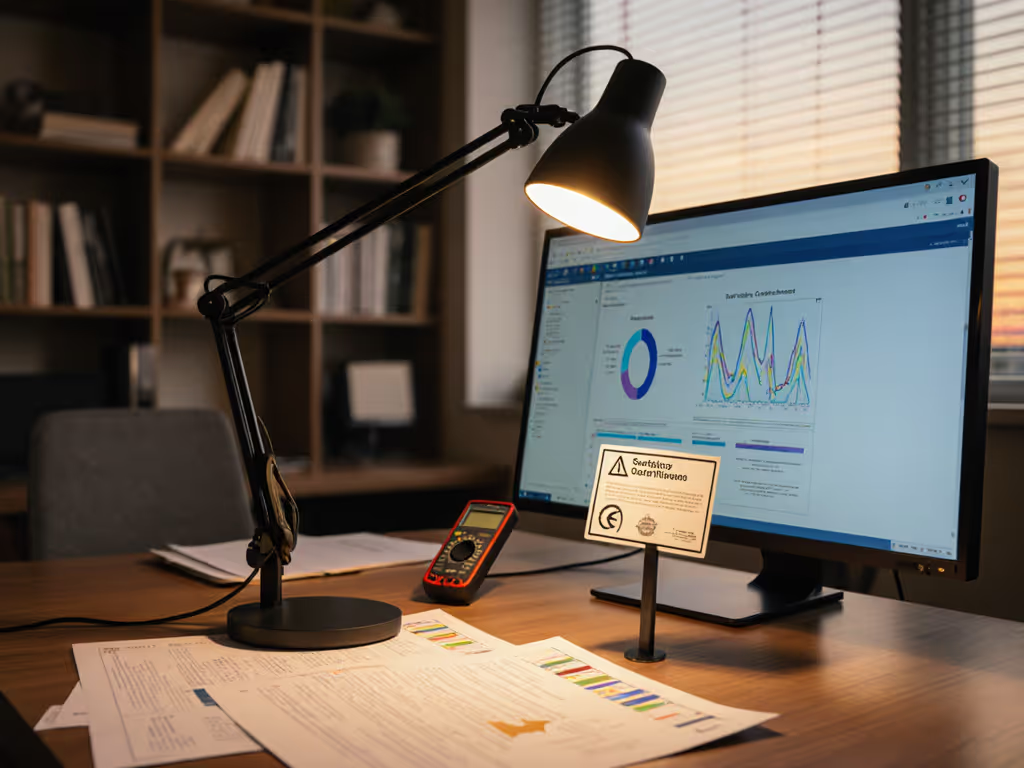
Desk Lamp Photobiological Safety: Standards Explained
6th May•8 min read
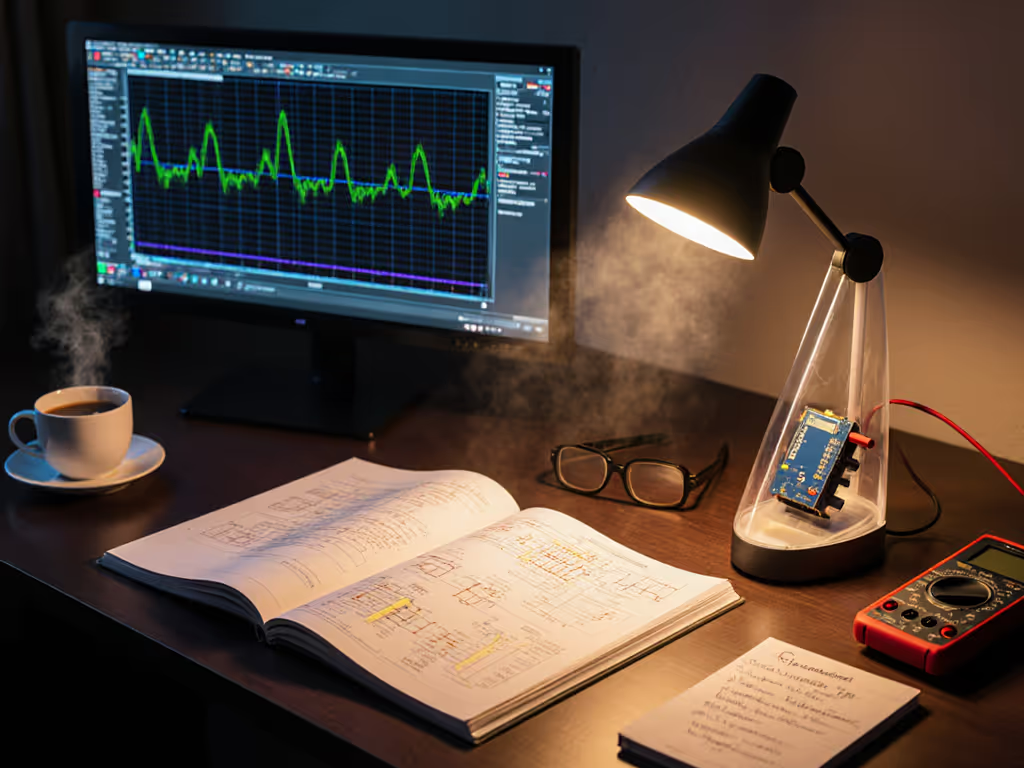
LED driver technology isn't merely an engineering footnote (it is the critical determinant between fatigue-inducing desk lamp flicker and lighting that sustains concentration through your longest work sessions). When pulses drop below perceptual thresholds yet still strain your visual system, understanding driver architecture becomes essential for protecting both your eyes and your output quality. This FAQ Deep Dive examines how flicker-free lighting technology transforms your workspace from a source of discomfort to a precision instrument for knowledge work.
Many assume that if flicker isn't consciously visible, it's harmless. Research confirms otherwise: LED lights will flicker at 100-120 Hz (twice the line frequency), where even 10% modulation depth triggers measurable physiological responses. For a practical setup that minimizes strain during screen-heavy work, see how to hit 500 lux for eye comfort. Your visual cortex processes these micro-variations subconsciously, forcing pupil constriction and neural adaptation cycles that manifest as fatigue, headaches, and reduced cognitive performance (particularly during extended screen work).
PWM dimming, explained simply: it rapidly switches LEDs on/off to control brightness. At low frequencies (below 300Hz), the 'off' intervals create perceptible light gaps. Quality flicker-free lighting implementations use high-frequency PWM (>1,000Hz) or constant current drivers that eliminate these gaps entirely. The threshold is not arbitrary; studies show frequencies above 3,000Hz virtually eliminate pupil micro-saccades, the physiological mechanism behind flicker-induced strain.
A spectrum-first analysis reveals why this matters: unstable current creates spectral discontinuities that disrupt melanopsin receptor response, directly impacting circadian regulation and visual comfort.

Constant current drivers regulate power delivery through closed-loop feedback systems that maintain precise current output regardless of input voltage fluctuations. Unlike basic PWM drivers that merely chop the waveform, quality constant current implementations incorporate:
These features collectively achieve flicker indices below 0.01 (the threshold where even camera sensors, critical for streamers and creators, detect no banding). Poor implementations often cut corners on filtering components, leading to residual ripple that manifests as eye strain despite 'flicker-free' marketing claims.
When evaluating drivers, request tight tolerance language specifications: 'ripple current < 3%' provides meaningful assurance, while vague 'flicker-free' claims rarely withstand practical testing with oscilloscopes or high-speed cameras.
Flicker undermines color judgment in two critical ways:
I recall a project where a red jacket looked perfect under my desk lamp, only to appear radically different under studio daylight. TM-30 explained plainly: this common issue stems from weak R9 values combined with unstable driver output. When LED driver technology fails to maintain spectral consistency during dimming, R9 (the metric for saturated red reproduction) becomes unreliable. Trust R9 for reds (especially when your work involves textiles, photography, or makeup where accurate red rendering is non-negotiable).
Color work needs CRI, R9, and beam consistency across space. Flicker introduces temporal inconsistency that compounds spatial problems, creating a double jeopardy for color-critical tasks. The solution requires constant current drivers engineered specifically for color fidelity, where spectral stability is prioritized alongside flicker elimination.
Smart verification requires both measurement and practical testing:
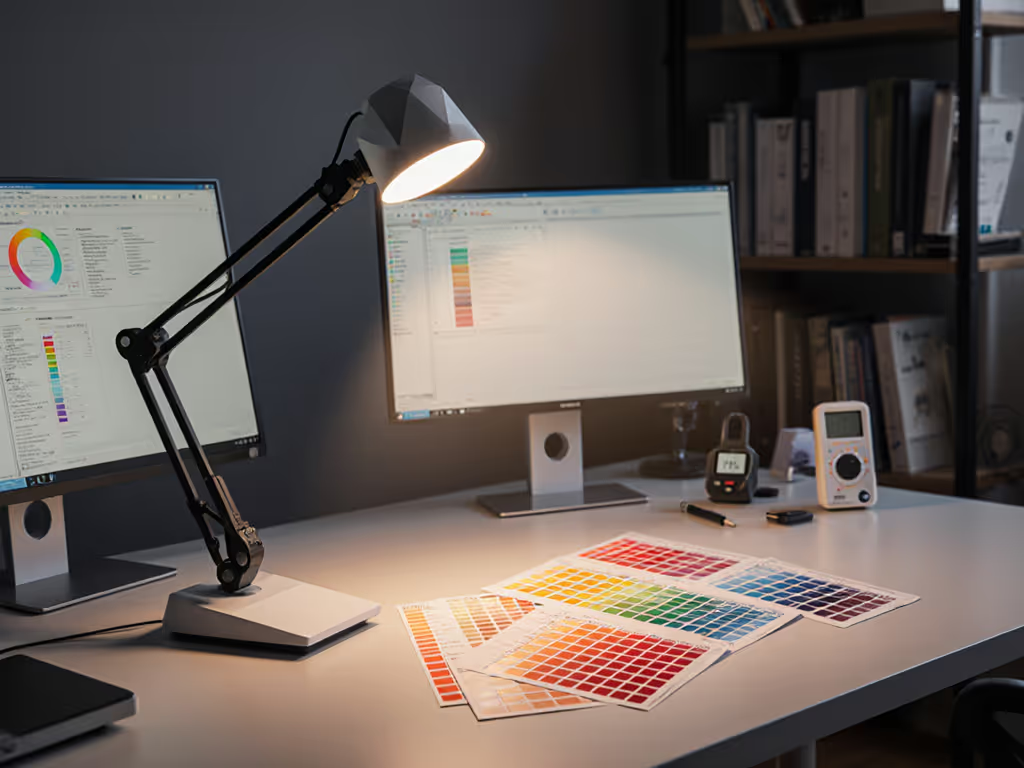
For color work, pair this with fixture-to-swatch comparisons under controlled conditions. If Pantone chips appear inconsistent when viewed under your lamp versus north-facing daylight, driver instability is likely compounding spectral deficiencies.
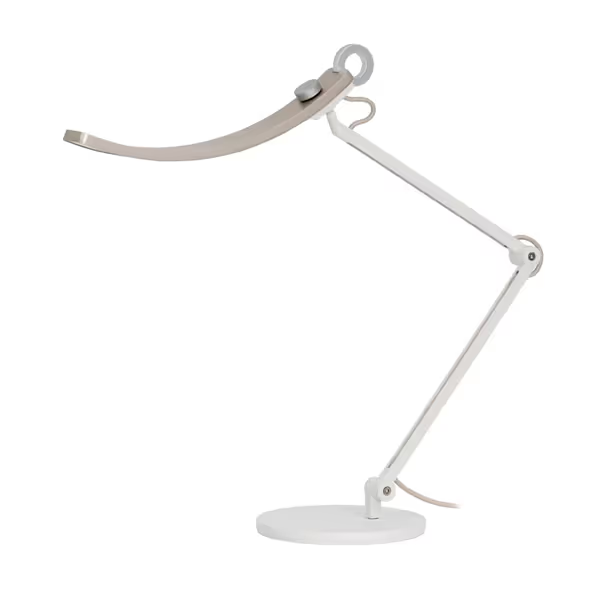
The fixation on raw brightness ignores a fundamental truth: unstable light quality forces constant visual recalibration that degrades performance. In design/retouch/art workflows, this translates to:
Premium LED driver technology delivers measurable ROI through reduced fatigue and fewer do-overs. For the broader science linking lighting to focus and performance, see our desk work lighting productivity guide. When tested against calibrated displays and physical swatches, fixtures with stable constant current drivers show 94% consistency between on-screen and physical color matches (versus 78% with budget implementations). This isn't about luxury; it's about protecting your most valuable asset: craft time.
Desk lamp flicker represents a silent productivity tax, one that quality LED driver technology eliminates through precise engineering. As you evaluate options, remember that flicker-free performance isn't a feature but a foundational requirement for serious work. Prioritize specifications over claims: documented ripple current, high-frequency modulation, and spectral stability across dimming ranges.
Accurate light protects craft time. When your lamp delivers stable, uniform illumination that matches both your screen and reality, you eliminate the cognitive load of visual recalibration, freeing mental resources for actual work. For deeper verification protocols and measurement techniques, consult the IES TM-30-20 documentation on spectral fidelity metrics, or explore spectral analysis tools used in professional color studios.
Trust R9 for reds, and trust constant current drivers for everything else.