
Circular vs Linear Desk Light Bars: Beam Patterns
10th May•12 min read
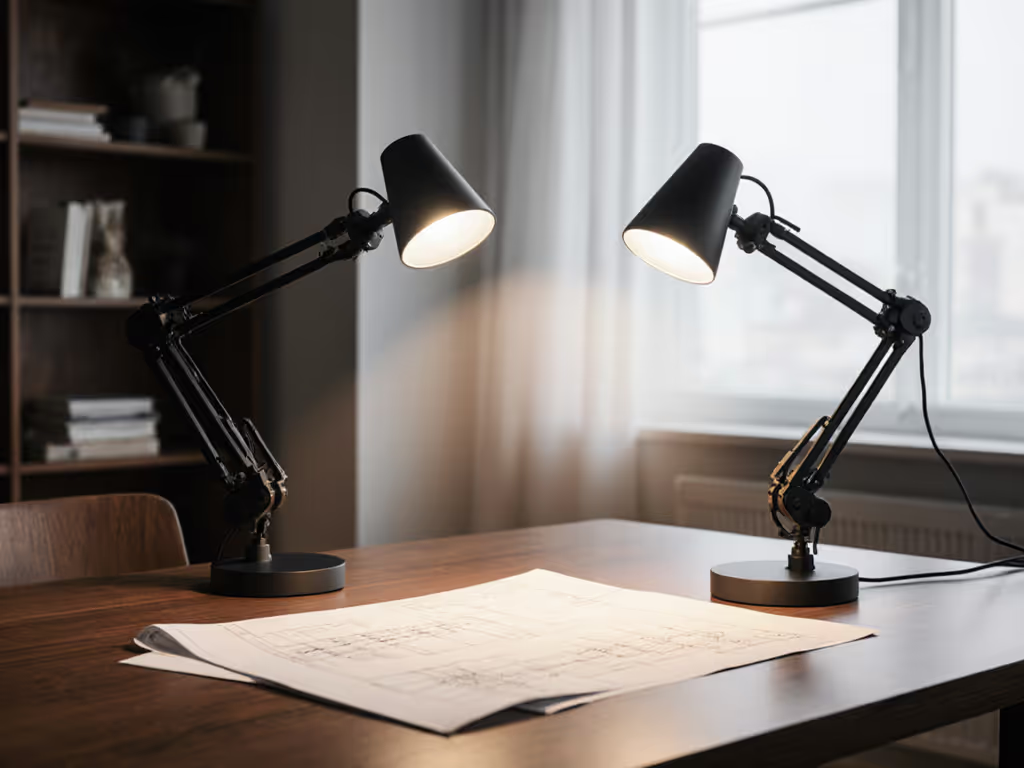
Articulated and telescoping lamp arms serve fundamentally different structural purposes, and the choice between them directly affects your desk-level illuminance uniformity, joint stability, and precision. Articulated arms pivot at multiple joints like a segmented limb, while telescoping arms extend and retract along a linear axis (each approach carries distinct trade-offs in reach, positioning accuracy, and the stability needed to maintain even light distribution across your work surface).
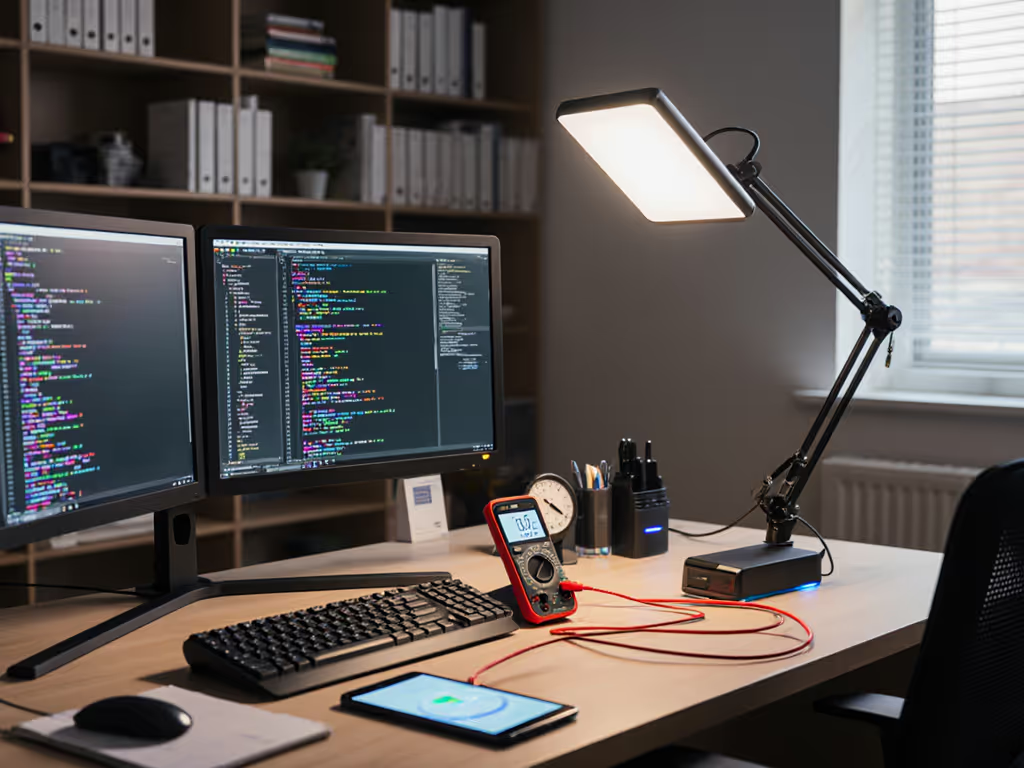
Most comparative discussions focus on cosmetics or marketing reach claims. Instead, this analysis centers on what actually matters for sustained deep work: Can the arm hold a stable position without drift? Does the mechanism allow precise height and angle adjustment without creating shadows or hot spots? And critically, does the arm's geometry support uniform, flicker-stable illumination at your desk?
Articulated arms employ multiple hinged joints (typically two to four depending on design complexity) to achieve movement across multiple planes. A classical two-joint articulated arm (upper arm + forearm) can reach approximately 32 inches from the base point, while three-joint designs extend further and compress more compactly.[1] For workspace fit and clearance planning, see our Desk Lamp Dimensions Guide. Each joint incorporates a friction mechanism, tension spring, or locking clamp to hold the lamp steady once positioned.
The fundamental strength of articulated geometry lies in directional precision. For a deeper comparison of height mechanisms (articulated vs telescoping and beyond), see our height mechanism comparison. Because each joint pivots independently, you can angle the lamp head down at a steep pitch while keeping the arm structure itself relatively compact. This is why articulated designs dominate high-precision workstations: they let the lamp sit closer to the desk plane and illuminate a smaller target area with concentrated, directional light.
However, articulated arms introduce a mechanical cost: rigidity degrades with each additional joint.[1] A two-joint arm can lock solid; a four-joint design, while more flexible, introduces cumulative play across the joints. If even one joint loosens over months of repositioning, the entire arm sags, and your carefully calibrated lux distribution collapses. I learned this the hard way during a week of night deadline work. What began as crisp, even desk-level illuminance degraded into harsh peaks where the arm held strong and frustrating shadows where a joint had developed play. Swapping to an arm with locking clamps at each joint resolved the drift, but the principle was clear: more articulation means more joints to fail.
Telescoping arms extend along a single linear axis, typically through one or two nested tubes that slide relative to one another. Reach often extends 27 to 32 inches depending on the number of segments and lock mechanism.[1] If you're using a sit-stand desk, our standing desk reach guide verifies which arms maintain coverage up to 42 inches. The structural advantage is simplicity: fewer moving parts mean fewer points of failure and typically superior long-term stability, especially under constant micro-adjustments.
Telescoping mechanisms rely on friction rings, friction collars, or threaded locks to hold extension position. High-quality designs incorporate tight tolerances and dual-friction surfaces that resist creep even under the weight of a substantial lamp head. Because there is no pivot point along the arm itself, a telescoping arm cannot steep-angle downward as easily as an articulated arm (instead, the entire arm rotates at its base joint). This geometry makes telescoping designs less suited to extreme angles but well-suited to lateral reach and horizontal positioning.
The real-world benefit emerges over time: a telescoping arm locked at a chosen extension stays locked. No joint wear, no drift, no weekly recalibration. For workflows where you position the lamp once and refine focus through the base joint and lamp-head rotation alone, telescoping geometry provides the passivity you need.
Both arm types must support a lamp head (typically 1 to 3 lbs) without sagging. Base choice also affects stability; compare clamp vs weighted bases for your setup. Sag (even a quarter-inch drop) shifts your desk-level lux distribution and reintroduces shadows that break uniformity.
Articulated arms distribute load across each joint. A two-joint arm in full horizontal extension can sag noticeably if joints rely on spring tension alone rather than positive locking. Mechanical advantage favors shorter arms; a 24-inch articulated arm is visibly more rigid than a 32-inch one.[1] Locking clamps at joints (versus friction-only) eliminate sag almost entirely but sacrifice smooth repositioning for a discrete, clamping motion.
Telescoping arms concentrate load at the friction lock. Single-tube designs can be prone to creep if the friction surface wears; however, dual-friction designs and screw-lock mechanisms provide near-zero sag. The trade-off is adjustment speed: a screw lock requires hand-turns rather than smooth sliding. To prevent eyestrain from PWM flicker, see our LED driver explainer for what to look for.
Uniformity implications: Desk-level lux, not marketing lumens: a 1200-lumen lamp with uncontrolled sag delivers worse uniformity (U0 < 0.5) than an 800-lumen lamp on a rock-solid arm (U0 > 0.65).
| Metric | Two-Joint Articulated | Telescoping (Single) |
|---|---|---|
| Typical Max. Reach | 28 to 32 inches | 27 to 32 inches |
| Minimum Retracted Depth | 8 to 12 inches | 4 to 8 inches |
| Downward Angle (from horizontal) | Up to 90°+ (steep) | 30 to 60° (moderate) |
| Lateral Swing | Full 360° (base-dependent) | Full 360° (base-dependent) |
| Footprint Compactness | Medium to large | Small to medium |
| Rigidity @ full extension | Fair to good (with locking) | Good to excellent |
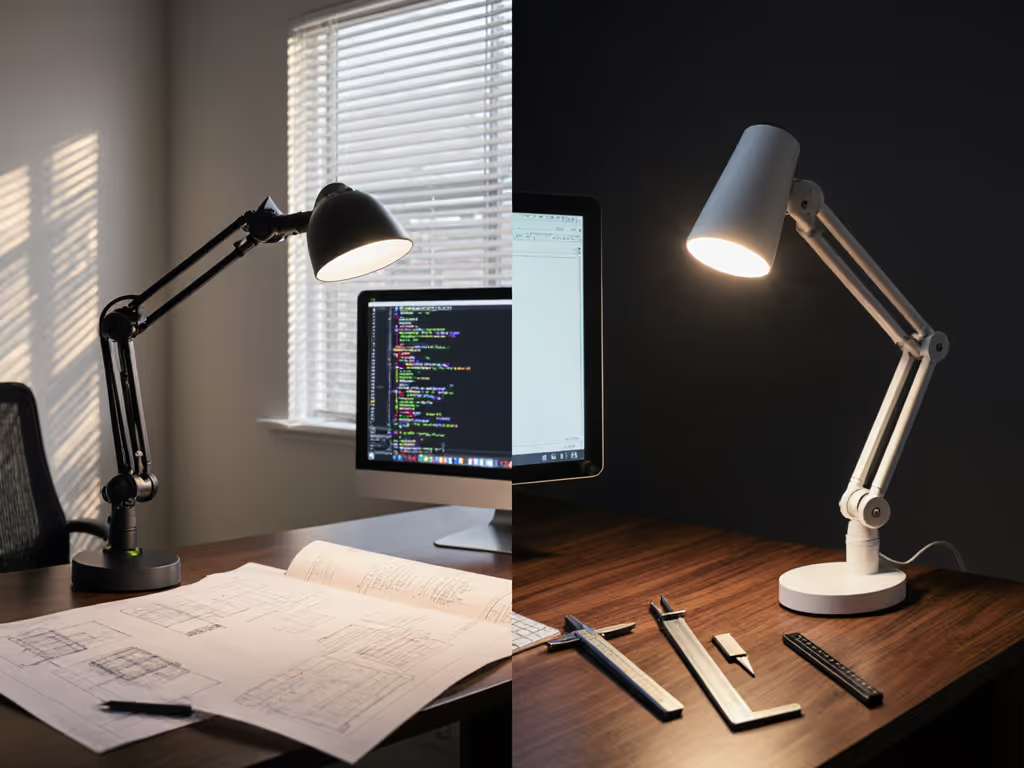
For small desks or where you frequently swing the lamp between tasks, the compact retracted profile of telescoping excels. For workstations where the lamp remains in one corner and you adjust height and angle only, articulated designs offer more granular downward positioning. Neither inherently wins; align the arm type with your task pattern, space constraints, and stability needs.