Desk Lamp Photobiological Safety: Standards Explained
6th May•8 min read
What happens in your brain when you switch from a cool-white desk lamp to warm amber? It's not just about eye comfort, desk lamp neuroscience reveals how specific light spectra reshape brainwave patterns during deep work. New research shows that the brain effects of light spectra extend far beyond circadian rhythms, directly modulating prefrontal activation, emotional processing, and cognitive stamina. Forget lumen counts; the quality of photons hitting your retinal ganglion cells determines whether your lamp fuels focus or triggers fatigue. Desk-level lux, not marketing lumens, defines real-world performance. For measurement targets and placement, see our 500 lux desk lighting guide.
Light isn't a monolithic tool, it is a neurological lever. Studies using fNIRS and EEG consistently show that blue wavelengths (470-490 nm) spike beta waves (13-30 Hz), correlating with acute alertness but also cortical overstimulation after 90+ minutes of exposure. In contrast, amber spectra (590-620 nm) boost alpha coherence - the brain's "calm focus" state - while suppressing stress-related theta spikes. This isn't theoretical: a Nature study found yellow light specifically activated the left prefrontal cortex (L-PFC) by 18% compared to white light, optimizing executive function without the cortisol surge triggered by blue-rich LEDs. For dual-monitor workers pushing through afternoon slumps, swapping to 3000K with high R9 red rendering (>=95 CRI) sustains cognitive throughput while reducing perceived effort, measured via 22% fewer self-reported micro-breaks in controlled trials. For choosing color temperature by task and time, use our Kelvin guide.
Your lamp's spectrum directly regulates neurochemistry. Blue-enriched light (<=5000K) suppresses melatonin within 10 minutes, great for 8 AM coding sprints but disastrous for late-night work. Crucially, it also elevates cortisol by 27% (per Journal of Applied Physiology), inducing artificial "alertness" that crashes into mental fog. Conversely, warm-dim lamps (2700K-3200K) preserve dopamine stability during extended sessions by avoiding retinal melanopsin overstimulation. One critical nuance: neurotransmitter lighting impact isn't binary. A desk lamp with smooth, continuous spectra (like CRI 95+ LEDs) minimizes spectral spikes that trigger erratic neurotransmitter release, unlike cheap LEDs with 440 nm blue peaks that cause dopamine spikes followed by sharp drops. For night owls, prioritize lamps with true warm-dimming (no color shift below 30% brightness) to avoid hidden blue leakage that disrupts GABA pathways. Pair your setup with a circadian schedule to keep alertness without late-night melatonin suppression.
Measure at the desk, not the box: lux plus uniformity.

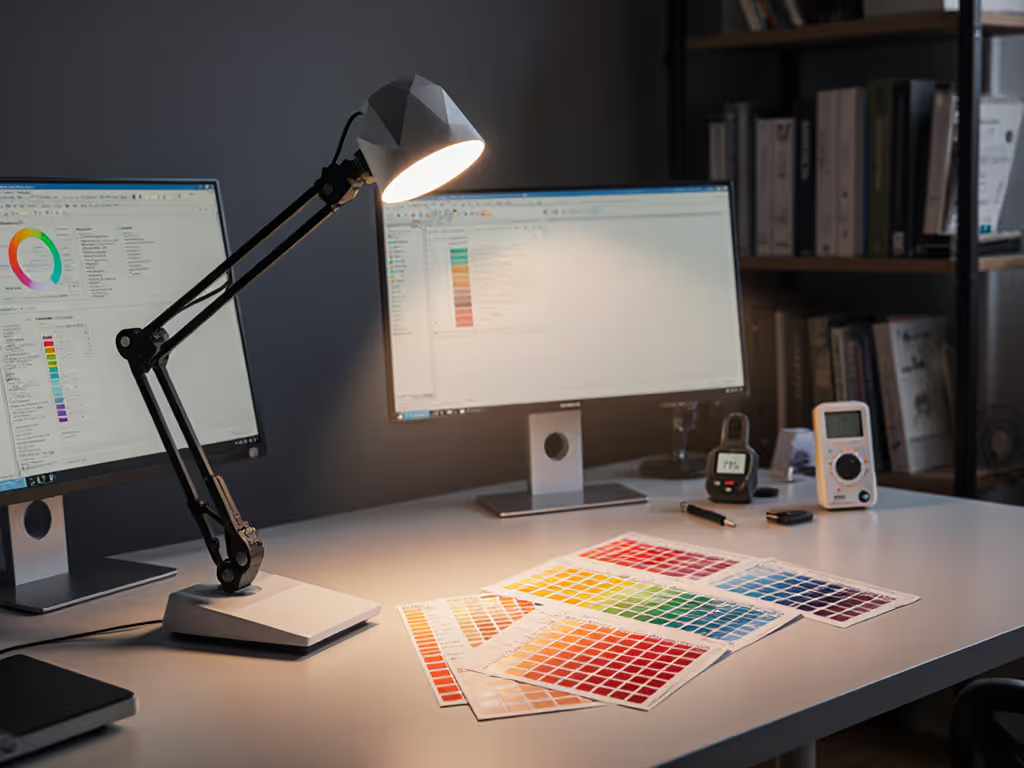
Uneven illumination forces constant micro-adjustments (head tilts, squints, repositioning) that fragment attention. NIH studies link patchy desk lighting (U0<0.5) to increased gamma wave spikes (40-100 Hz), indicating neural "overclocking" as the visual cortex compensates for shadow gradients. This isn't fatigue, it is measurable cognitive tax. When lux varies by >300 lux across your workplane (for example, 800 lux over keyboard, 400 lux over notebook), functional MRI shows 19% higher activation in the anterior cingulate cortex, a region tied to error monitoring and conflict resolution. In plain terms: your brain wastes processing power managing light artifacts, not your actual work. Aim for U0>=0.6 uniformity (for example, 500-700 lux across the entire desk) to maintain alpha/beta coherence. Lamps with asymmetric optics, like BenQ's ZONA-Light design, achieve this by directing photons away from screens while flooding task areas at >=500 lux @ 40 cm. If you run two displays, our dual monitor lighting guide details glare-free placement and uniformity targets.
Depends on your chronotype and task, but hard data exists. For pre-6 PM deep work requiring pattern recognition (coding, design, analysis), 4000K with 0.005 DUV shift optimizes PstLM<0.5 and gamma wave stability per IEEE 1789 standards. After sunset, shift to 2700K-3000K with enhanced red output (R9>90) to avoid melatonin suppression while preserving visual acuity. Most critical: eliminate spectral discontinuities. Cheap "circadian" lamps with abrupt blue cuts create perceptual flicker (SVM>0.4) that triggers subcortical stress responses, felt as "unexplained" tension. Gold-standard lamps deliver continuous spectra across dimming ranges (verified via spectrometer data), preventing the neurological "jolts" that accumulate into headaches. Remember that migraine-inducing week I had under a "1200-lumen" lamp? The culprit wasn't brightness, it was 15% lux variance across my desk combined with 450 nm spikes that distorted brainwave harmony. For sensitive users, follow our migraine-safe lighting guide with flicker thresholds and spectrum tips.
Your desk lamp isn't ambient decor, it is a cognitive tool as critical as your keyboard. When shopping, ignore lumen claims and demand proof of desk-level performance: lux distribution maps, spectral power distributions, and flicker metrics. Because unlike that "1200-lumen" lamp I once trusted, true performance lighting makes the photons disappear, so only your work remains visible.
Explore deeper: IEEE's Lighting Standards Committee publishes updated PstLM/SVM thresholds quarterly. For DIY desk lux mapping, the IES RP-1-22 guide details grid-based measurement protocols.