Desk Lamp Photobiological Safety: Standards Explained
6th May•8 min read
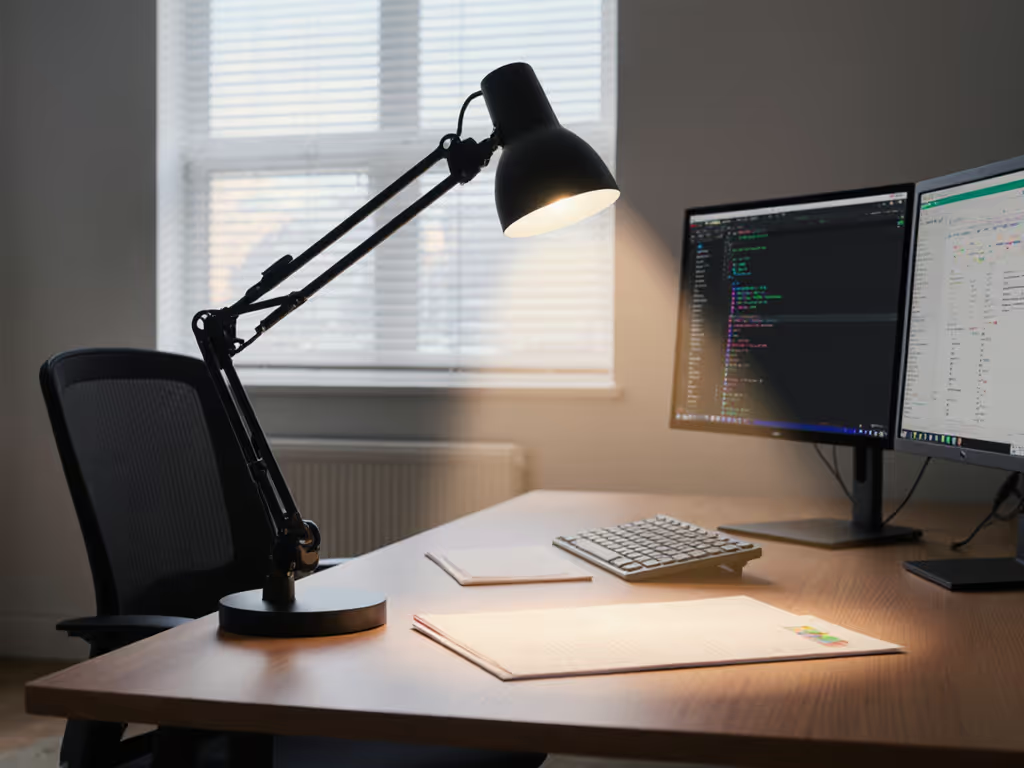
Circadian lighting placement determines whether a lamp's spectrum actually influences your biological clock, or merely illuminates your desk. Position matters because circadian photoreception depends on light reaching photosensitive ganglion cells in the retina, a process governed by geometry, timing, and spectral composition. Unlike task lighting, which can sit anywhere that erases shadows, workstation circadian optimization requires deliberate height and angle to deliver effective light to your eyes throughout the day while supporting sleep at night.
The human circadian system doesn't simply detect light versus darkness; it responds to how much light reaches the eye and when that light arrives. Research confirms that circadian-effective lighting systems can shift wake-up times by 30-45 minutes in shift workers and improve alertness across office environments[2]. However, a lamp placed too low, angled away, or positioned behind your head delivers far less circadian stimulus than one calibrated to reach your eye line at the desk.
The challenge is that circadian lighting geometry adds a constraint traditional desk lamps ignore: you need sufficient illuminance on the work surface and adequate light at eye level. A lamp that floods your desktop with 500 lux but casts shallow light onto your face may fail to suppress melatonin or phase-shift your clock. Conversely, a lamp angled directly at your eyes delivers strong circadian signals but risks glare and reduced contrast on your screen or reading material.
Start with controllable contrast: position your lamp so light reaches both your work plane and your upper visual field, with minimal glare. For evidence-based brightness targets and measurement tips, see our 500 lux desk lighting guide. This requires precision, standards-based thresholds, and an understanding of how your desk geometry, monitor height, and work habits shape optimal placement.
Standard guidance specifies at least 200 equivalent melanopic lux (EML) at eye level, measured four feet above the floor facing forward[5]. For most people seated at a desk, this translates to a lamp positioned 18-36 inches above the work surface, depending on lamp output, beam width, and distance from your eyes.
If you use day/night workspace lighting with both ambient overhead fixtures and a task lamp, placement strategies differ:
For desk lamp height for circadian health, the sweet spot lies in the upper-intermediate range: 24-28 inches for most people. At this height, a 4000-5000K lamp with 30-50° beam spread delivers substantial light to the eye (200+ EML with typical 400-600 output lumens at 24 inches) while keeping direct glare manageable and shadows minimal.
Optimal light schedules depend on your chronotype (your natural work-sleep tendency). Research shows that employees with slower-running internal clocks (intrinsic periods longer than 24 hours) benefit from later afternoon light peaks, while fast chronotypes need earlier afternoon exposure[2]. A lamp with adjustable height and angle allows you to fine-tune this without replacing equipment.
Recommendation: Choose a lamp with articulated arms and smooth height adjustment. This lets you raise the lamp in morning sessions (closer to eye level, stronger circadian signal) and lower it during afternoon focus work (reduced blue-light glare on screens), then reposition it for evening warm-dim routines.
The circadian lighting geometry that maximizes circadian photoreceptor activation is forward-facing, at or slightly above horizontal eye level. Light approaching the eye from above or level causes less glare than light from below (which bounces off glossy surfaces), and maintains visual contrast on your monitor by avoiding bloom onto the screen.
The asymmetry matters. Unlike overhead ambient light (which diffuses evenly), a focused task lamp's angle controls where shadows fall and how much light spills onto your monitor. By adjusting angle, you can tune the balance between melatonin-friendly lighting placement at night and alertness-optimizing geometry in the morning.
A practical workflow uses two positioning states: one for morning focus and circadian alignment, another for evening wind-down and sleep support.
This approach aligns with standards guidance on seasonal and schedule-dependent lighting adjustment[1]. For a step-by-step plan, follow our circadian desk lamp schedule. By repositioning and retuning, you harness the same fixture across your entire circadian cycle rather than switching lamps.
Glare from placement that sends light directly onto monitor glass or highly reflective desk surfaces undermines circadian benefit by reducing perceived contrast and forcing pupils to constrict, ironically lowering retinal illuminance despite high lux output.
Control glare through geometry:
Use this framework to audit and adjust your current setup:
Circadian lighting placement is not a one-time calibration; it evolves with seasons, work schedules, and personal response. Begin by setting a fixed morning position (24-28 inches, 30-40° angle, 5000K+, full brightness) for one week. Log your wake time, alertness at 10 a.m. and 3 p.m., and evening sleep quality. Then implement the evening repositioning (lower, warmer, dimmer) for a second week and repeat the log.
Compare the two periods. If morning alertness improves and evening wind-down eases, you've validated the geometry for your space and chronotype. If not, shift the lamp 2-3 inches higher or lower and retest. Most people converge on optimal placement within 2-3 weeks of deliberate adjustment.
Document your preferred heights and angles (write them down or photograph the lamp position) so you can replicate the setup if your lamp is moved, shared, or adjusted by someone else. This small act of standardization prevents drift and ensures consistent circadian support over months.