
Circular vs Linear Desk Light Bars: Beam Patterns
10th May•12 min read

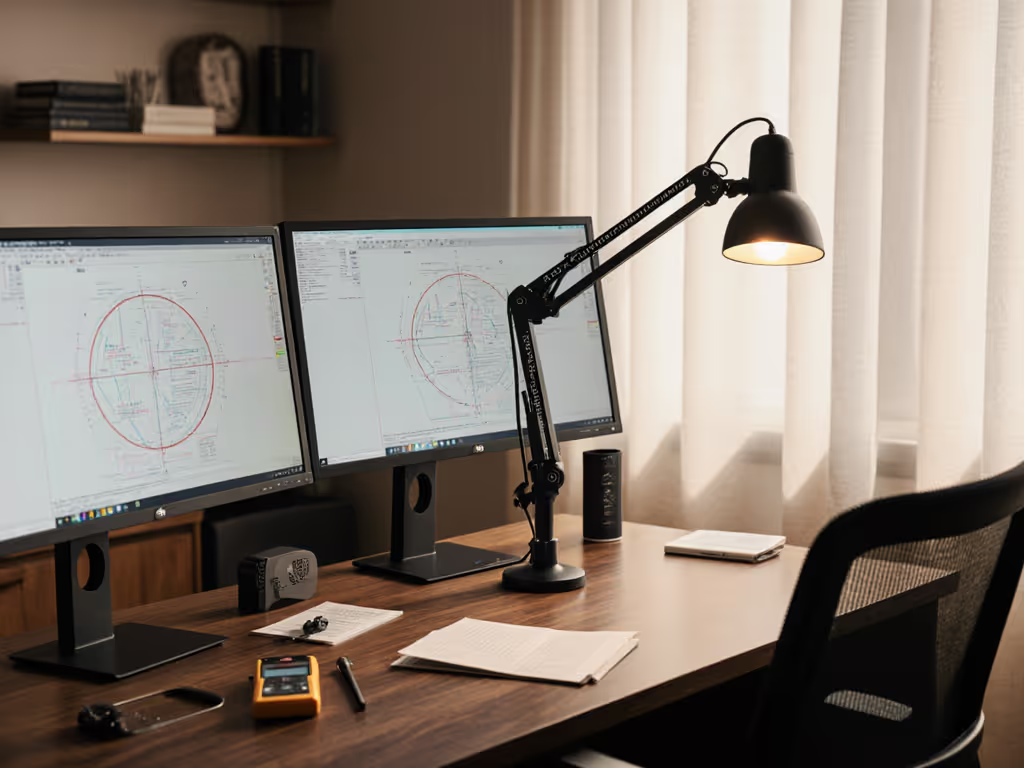
When you're working on a small desk, the difference between articulated vs telescoping arms feels academic (until your lamp drifts mid-meeting or can't reach the corner where you actually need light). The mechanism that holds a lamp's arm in place determines not just comfort, but whether you get consistent, predictable illumination across sessions. Desk lamp arm mechanisms vary wildly in their engineering approach, and most people discover the tradeoffs only after the purchase fails them. Understanding the mechanics behind each design isn't about aesthetics or marketing claims; it's about identifying which construction will stay positioned, deliver reliable reach, and hold up under the small daily torques that cheap joints can't survive.
You've likely experienced the frustration: a lamp positioned perfectly this morning sits at a useless angle by afternoon. The head droops. The reach doesn't extend far enough to clear a tall monitor or illuminate a drawing pad's far edge. If monitor height or desk elevation is your bottleneck, see our standing desk reach tests to pick an arm that actually clears your setup. You shimmy it back, and within hours (or days), it's adrift again. This isn't minor annoyance; it's a productivity leak. Every repositioning breaks focus. Every failed reach forces awkward posture or additional fixtures.
The culprit is almost always the joint: poor torque specifications, springs that fatigue, friction mechanisms that wear, or arm geometry that fundamentally can't support weight at certain angles. Most budget lamps spec their arm adjustability without specifying how stable that adjustability is, a gap that costs time and comfort.
Manufacturers tout "360-degree rotation" and "fully articulated" as if those phrases guarantee reliable positioning. They don't. After returning three 'deal' lamps that buzzed or drooped, I spent a weekend shimming joints and measuring flicker next to my kid's homework. The cheapest winner wasn't the brightest; it held position, dimmed smoothly, and kept positioning stable. That lamp paid for itself in calmer evenings and fewer returns.
The core issue: two different mechanical philosophies compete for your desk, and they excel in opposite conditions. One prioritizes infinite flexibility; the other prioritizes locked-in stability. Reaching for one when you need the other guarantees buyer's remorse.
Articulated arms use a series of joints (typically two to three pivot points along the arm's length) to create bendable positioning. Each joint relies on friction, springs, or mechanical locks to resist gravity and maintain position.[2] The Italian design tradition uses a parallelogram linkage with rubber friction in the gap: gravity deforms the geometry, pressure on the rubber increases, and friction holds the arm.[2] Other designs employ compression springs that counteract weight regardless of arm position.[2]
The multi-joint design allows the arm to snake around obstacles and reach into spaces a rigid arm cannot. You can bend the lamp down to desktop level, up and over a tall monitor, or at a forward angle that places the head directly above your work surface. This adaptability is invaluable on small desks where every angle matters. The distributed joints also make the lamp feel lightweight in hand during adjustment, with low perceived resistance.
Multiple joints mean multiple wear points. Each pivot is a potential source of loosening, creep (slow drift under load), or stalling if friction degrades. Rubber friction systems soften with heat and age. Spring-based systems can fatigue or lose preload. After 18 to 24 months of daily repositioning, many articulated arms develop a subtle play (not dramatic slump), but enough that you'll notice they don't hold a precise reading angle as firmly as they did new.
Stability testing reveals the weakness: apply steady side-load to an articulated head and measure deflection. Budget articulated arms often show 2 to 5 cm of sag at full extension when loaded with a typical LED head (500 to 800 g). Base mass and balance also matter—compare options in our desk lamp weight guide to trade portability vs stability. Higher-end designs with reinforced joints and stiffer springs perform better, but the penalty is higher friction during adjustment (defeating the appeal of easy repositioning).
Telescoping arms extend and retract along a single axis (typically with minimal joints or articulation).[3] The arm itself is rigid or semi-rigid; reach is achieved by sliding the outer tube over the inner tube, locking in place via friction ring, cam, or detent mechanism.[7]
With fewer joints and a solid core, telescoping arms are inherently stiffer. Load the head at full extension and deflection is typically 0.5 to 1.5 cm, a significant reduction compared to articulated peers. The locked extension acts like a cantilever beam: simple geometry, predictable behavior. For tasks requiring a stable, unmoving light source (detailed drafting, precision color work, photo editing), this rigidity is an asset.
Telescoping mechanisms also tend to age better. A well-designed friction ring or cam-lock (like the prototype shown in precision lighting forums) can be adjusted or replaced if it loosens, whereas internal springs in articulated arms often cannot.[7]
Telescoping arms don't bend. They extend straight out from the base. If your base is off to one side and you need light at an angle above or below desktop level, a telescoping arm becomes awkward. You can't snake it around a monitor or down to table level without moving the entire base. To solve base placement constraints, compare clamp vs weighted bases and other mounts for stability and space savings. On a small, crowded desk, this inflexibility can be a deal-breaker.
Additionally, reach is finite. If your desk is 60 cm deep and your lamp's telescoping arm maxes out at 50 cm from the base, you cannot illuminate the far edge without base repositioning. Before buying, match specs to your space with our Desk Lamp Dimensions Guide.
Both arm types rely on control mechanisms to lock position. The quality of these mechanisms defines usable durability.
Traditional friction-based articulated arms hold position through pressure and resistance. Strengths: fine-grain adjustability and low cost to manufacture. Weaknesses: friction degrades with dust, heat, and repeated compression; adjustment force can increase over time as friction surfaces wear, and it is difficult to predict the failure point.
Spring-based articulated arms counteract gravity continuously.[2] The head resists dropping regardless of angle, which theoretically maintains position without wear. Reality: springs fatigue, especially in cheaper designs. Preload (initial compression) gradually decreases, so the arm holds position less firmly over time. Replacement typically requires full disassembly.
Cam-locks (rotating mechanical stops) and friction rings offer discrete locking with audible or tactile feedback.[7] Advantage: once locked, the arm behaves like a rigid cantilever; no gradual creep. Disadvantage: requires deliberate locking, and it is easy to skip this step and end up with unintended drift. Some users report friction rings becoming difficult to tighten after a year of use.
Detent mechanisms (notched or detent-button systems) provide discrete extension steps, so reach is limited to preset distances. This sacrifices fine adjustment for simplicity and reliability.
For knowledge workers and creatives, reach capability and positioning ergonomics are non-negotiable.
| Factor | Articulated Arm | Telescoping Arm |
|---|---|---|
| Max comfortable reach from base | 40 to 60 cm (depends on number of joints) | 50 to 80 cm (lighter, extends further) |
| Positioning flexibility (angles) | Infinite; can bend around obstacles | Limited to straight extension + base position |
| Micro-adjustment ease | Fine-grain; small movements possible | Coarser; locked intervals or friction-based |
| One-hand repositioning | Easy (low friction) | Moderate (requires unlocking, then repositioning) |
| Stability at full extension | 2 to 5 cm sag under 700 g load | 0.5 to 1.5 cm sag under 700 g load |
| Stability 12+ months in | Degrades gradually; creep increases | Holds stable if locking mechanism is maintained |
| Repair/replacement difficulty | Internal springs/friction hard to access | Friction ring or cam often adjustable or replaceable |
For small desks with tight constraints (dual monitors, deep work surfaces, limited floorspace), articulated arms excel because they navigate around clutter. For complex layouts, follow our L-shaped and standing desk placement to prevent glare and shadows. For focused, single-task desks where repositioning happens infrequently, telescoping arms offer superior rigidity and peace of mind.
Value is lumen control, not coupons: right light, right task (and that requires a mechanism that stays right). Cheap articulated arms with compression springs typically degrade within 18 months of regular repositioning. Articulated arms with high-quality parallelogram linkage and reinforced rubber (Italian-style) hold up better, but command higher prices. Telescoping arms with sturdy friction rings or cam-locks often outperform articulated peers in longevity, especially if the locking mechanism is user-adjustable (a feature rarely documented in specs).
Key durability markers: look for designs with reinforced joint housings, metal-on-metal friction surfaces (rather than plastic), and accessible adjustment points. Cheap that lasts beats pricey that drifts, a principle that applies equally to both arm types.
Articulated and telescoping arms are not better or worse; they solve different problems. Articulated arms prioritize flexibility and obstacle navigation, making them ideal for crowded desks and frequent task-switching. Their stability can degrade over time, but the tradeoff is immediate, tactile control. Telescoping arms prioritize rigidity and reach, excelling in spacious, focused workflows where the light rarely needs repositioning and precision matters.
Before buying, audit your desk: How much space do you have? How often do you reposition the lamp? Are obstacles (monitors, equipment) fixed? Do you need the light to reach the desk's far edge, or is mid-range sufficient? If your desk is small and cluttered, articulated flexibility wins. If you have room to work and stability is non-negotiable, telescoping reliability wins.
The lamp that holds its position without complaint, dims smoothly, and delivers the right light to the task... that's the lamp that pays for itself in focus and comfort. Measure joint torque, test reach at your actual desk distance, and confirm that the arm type matches your constraints. Your future self, still using the lamp after a year, will thank you.