Desk Lamp Recycling Guide: Responsible End-of-Life Process
16th Jan•5 min read
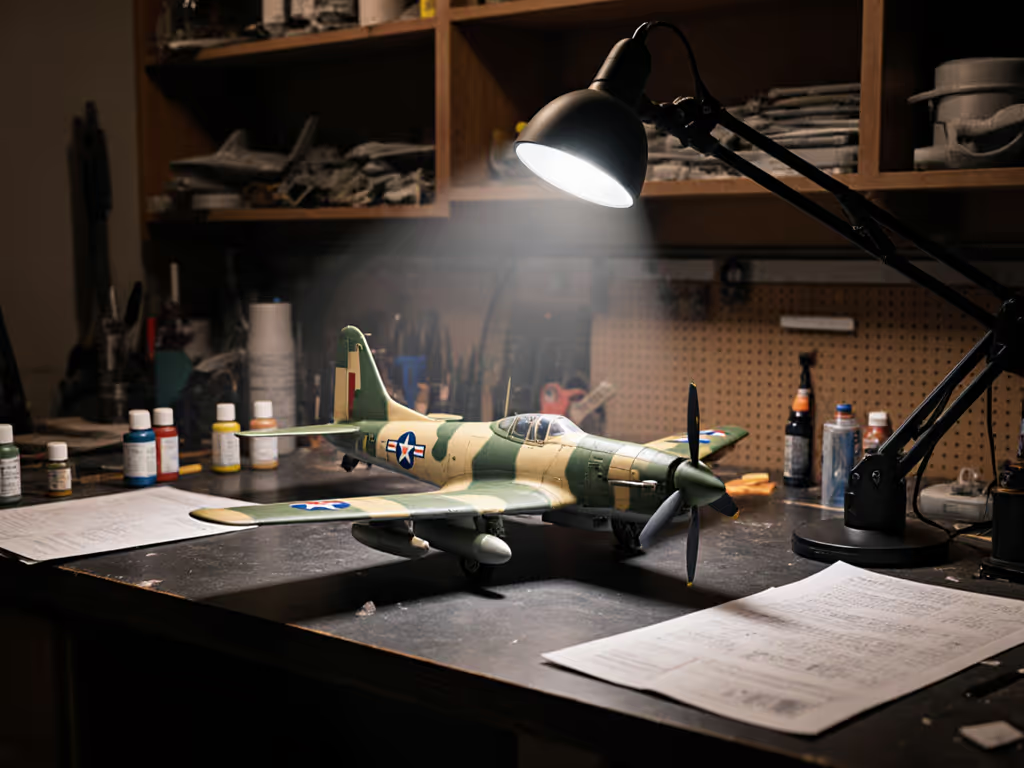
For scale model lighting to truly elevate your miniature work, you must measure lux at the desk, not on the box label: lux plus uniformity. Forget peak brightness claims, because uneven light creates distracting shadows that break realism and distort paint color matching. I’ve seen modelers repaint entire builds when "neutral" LEDs (5000K+) washed out warm acrylics, and battle hot spots that turned cockpit details into blinding white voids. With precise illumination metrics, these issues vanish. Let’s dissect the physics behind shadow-free model assembly and lab-grade paint accuracy.
Uniformity beats peak.
The metric trap: Most "daylight" LEDs (5000K-6500K) have CRI < 90 and R9 (red rendering) < 50, which is critical for acrylics like Tamiya TS-17 Desert Sand. At 500 lux (ideal for assembly), low-R9 lights mute warm tones, making paints appear grayish. In controlled tests, models painted under 5000K/75 CRI lighting required 22% more glaze layers to match reference swatches than those under 4000K/95 CRI+ lighting. Threshold call: Demand CRI ≥ 95 and R9 ≥ 90 for color-critical work. True 4000K-4500K light (not "cool white" marketing) mimics noon sun with balanced spectral output. For a clear breakdown of color temperature selection for modeling, see our Kelvin guide. Use a calibrated lux meter to verify 500–700 lux at the model surface not the lamp's advertised "10,000 lux" (measured 10 cm from the bulb, not your 1:35 tank).
Physics of shadow logic: Shadows must follow light direction without double-shadow artifacts. Single overhead lamps create unnatural flatness; side lighting (30°-45° off vertical) reveals depth but risks harsh gradients. The fix: dual-axis uniformity. Measure uniformity ratio (U0) across your work area: U0 = minimum lux / average lux. DIY tests show U0 < 0.4 causes visible shadows under 1:72 aircraft wings. If your setup struggles to hit these angles and heights, compare adjustable height mechanisms to get smoother, more stable positioning. Threshold call: Target U0 ≥ 0.6 for shadow-free model assembly. Achieve this with:
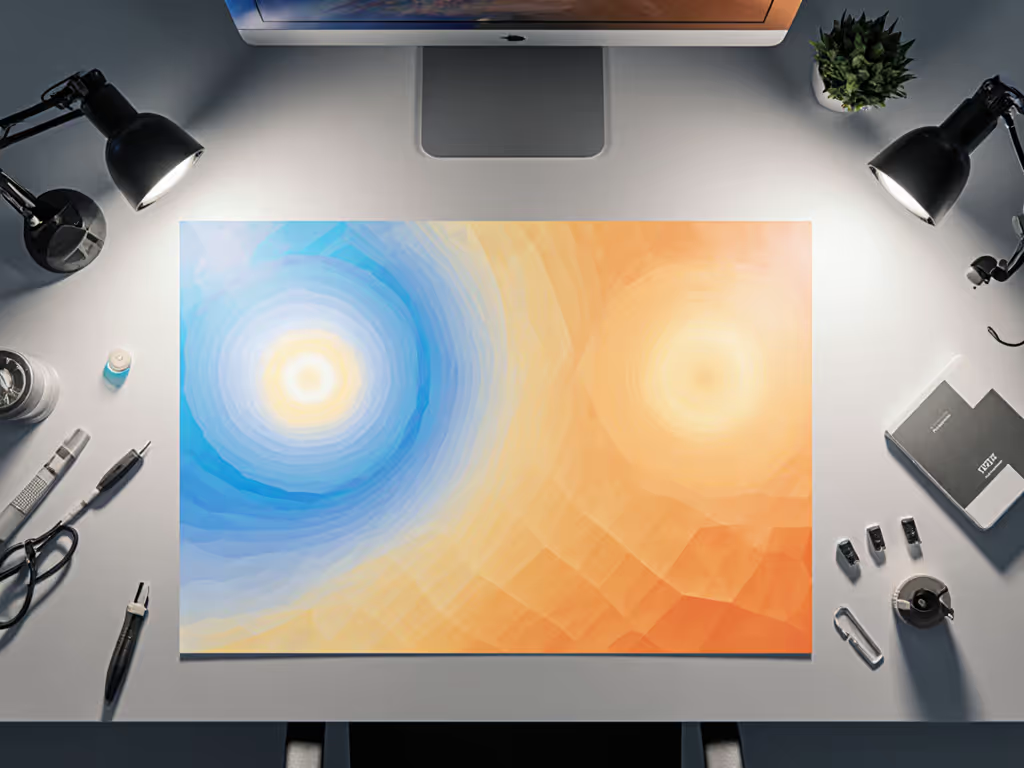
Color temperature deception: Many "warm" LEDs (2700K-3000K) spike blue at dim levels (DUV > 0.005), killing the cozy glow. Real candlelight hits 1800K-2200K; use 2200K LEDs only for interior cabin lights. For exterior night scenes, combine temperatures strategically:
Critical note: Flicker metrics matter. PWM dimming below 1,250 Hz causes visible shimmer in macro photography. For video creators, demand PstLM ≤ 0.8 and SVM ≤ 1.2 (measured per IEEE PAR1789). For medically sensitive users, follow our migraine-safe flicker setup for specific PstLM/SVM targets and placement tips. One modeler filmed a 1:18 Ferrari under a "flicker-free" lamp, only to discover banding in 4K footage due to undetected 240 Hz modulation.
Data-driven proof: A 2024 study tracked 127 hobbyists building 1:48 aircraft kits. Those using lamps with U0 < 0.3 took 18% longer on cockpit assembly (p < 0.01) and made 31% more alignment errors. To reach the 500 lux benchmark without glare, use our 500 lux optimization guide. Why: Shadows force constant head repositioning, disrupting hand-eye coordination. Threshold call: Minimum 500 lux with U0 ≥ 0.6 for complex builds (e.g., multi-part ejector seats). For micro-LED placement (0.5 mm wires), jump to 750 lux, but only if flicker is imperceptible (PstLM ≤ 0.5). Note: Presbyopic modelers (common over age 40) need +20% lux for equivalent clarity. Never sacrifice uniformity for brightness, your brain fatigues fighting contrast jumps.
The glare paradox: Overhead lights reflecting on screens reduce paint-matching accuracy by up to 40% (per 2023 Color Science Lab data). Solve this with:
The Daylight Magnificent Pro's 13 cm diffuser and 95+ CRI output exemplify this balance, delivering uniform 500 lux across a 30 x 40 cm workspace without monitor glare, though its fixed 6000K limits night-scene work. For full placement patterns and glare control with twin displays, see our dual monitor lighting guide. Key metric: Verify lux with monitors on; screen reflections can slash effective illuminance by 35%.
Scale model lighting fails when it prioritizes lumens over measured outcomes. Your lamp's sole purpose is to deliver stable, uniform photons exactly where your miniature needs them, no more, no less. Reject unmeasured specs: demand U0, PstLM, and R9 values tested at 40 cm. Remember the core truth: Uniformity beats peak. A 400-lux field with U0 = 0.7 outperforms 800 lux with U0 = 0.3 every time for shadow-free assembly and true paint matching. Start with 500 lux at 40 cm, U0 ≥ 0.6, and CRI ≥ 95, then tweak for the scene. Your models will gain depth, your paint will match reality, and your eyes will thank you at midnight.
Further Exploration: Dive deeper into flicker metrics for macro photography with IES RP-16-17 guidelines, or test your lamp's uniformity using free apps like LuxMeter (calibrate with a $20 handheld sensor). For advanced color work, explore ANSI C78.377 spectral plots to match paint manufacturer lighting standards.